| Factor | Return | Z-Score | 5d Z | 20d Z | 63d Z | Category | Meaning |
|---|---|---|---|---|---|---|---|
| Short Sale | +0.17% | z=+1.23 | -0.37 | -1.53 | -4.02 | Dynamics | prior-day shorts outperform — squeeze signal |
| Momentum | +0.52% | z=+0.69 | 0.01 | -0.42 | 1.02 | Style | 1-year moves trend |
| Semis | +0.38% | z=+0.65 | -0.06 | 0.80 | 2.55 | Theme | semiconductors exposure outperforms |
| Oil | +0.38% | z=+0.55 | -0.34 | -0.25 | -0.30 | Theme | oil exposure outperforms |
| Residual Volatility | +0.06% | z=+0.11 | -2.24 | -0.10 | 0.63 | Style | high volatility outperforms |
SpaceX debuts tomorrow in an offering valuing the aerospace company at nearly $1.75 trillion, prompting index providers to fast-track its inclusion into major equity benchmarksFinancial TimesEconomic Times. Passive funds are selling existing liquid tech holdings to fund this allocation, sparking gross exposure reductions across active books.
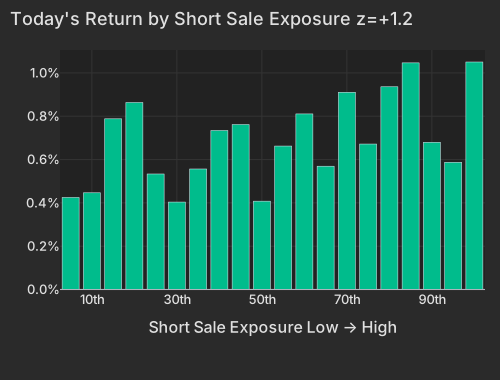
The clearest footprint of this unwind is in the Short Sale factor, which rose +0.17% (z=+1.23) today. Over the past 63 days, Short Sale operated at an extreme z_63d=-4.02, generating consistent negative returns. Today, that regime reversed. As funds reduce tech exposure, they are covering shorts to balance their books, driving a squeeze in heavily-shorted value equities. The SPDR S&P Regional Banking ETF (KRE) gained +0.44% today, extending a 5-day return of +5.54% as capital rotated into financials and REITs.
| Bucket | Avg Ret Pct |
|---|---|
| 1 | 0.42 |
| 2 | 0.45 |
| 3 | 0.79 |
| 4 | 0.86 |
| 5 | 0.53 |
| 6 | 0.40 |
| 7 | 0.56 |
| 8 | 0.73 |
| 9 | 0.76 |
| 10 | 0.41 |
| 11 | 0.66 |
| 12 | 0.81 |
| 13 | 0.57 |
| 14 | 0.91 |
| 15 | 0.67 |
| 16 | 0.94 |
| 17 | 1.05 |
| 18 | 0.68 |
| 19 | 0.59 |
| 20 | 1.05 |
Within the technology sector, index selling and fundamental repricing are driving a divergence between software and hardware. Oracle reported an earnings-per-share beat but fell -9.56% after management projected a $70 billion AI infrastructure buildout funded by a $20 billion capital raiseCNBC. Capital-intensive software models traded lower; the iShares Expanded Tech-Software Sector ETF (IGV) fell -1.13% today and -8.60% over the past 5 days. Adobe (ADBE) declined -0.41% ahead of its earnings report tonightBloomberg.
Conversely, semiconductors remain immune to software multiple compression. The Semis factor gained +0.38% (z=+0.65) today, extending a notably persistent trend (z_63d=+2.55). Intel (INTC) gained +4.59% and Applied Materials (AMAT) rose +4.84%. The SPDR S&P Semiconductor ETF (SMH) added +2.21%, decoupling from Asian macro weakness where South Korea's KOSPI index fell 9% over the past two sessions on memory chip profit-takingEconomic Times.
| ETF | Theme | Today | 5d | 20d | 63d |
|---|---|---|---|---|---|
| EWY | south korea | +3.60% | -16.20% | -0.03% | +34.32% |
| SMH | semiconductors | +2.21% | -10.50% | +1.72% | +42.36% |
| KRE | banking | +0.44% | +5.54% | +5.00% | +11.97% |
| IGV | software | -1.13% | -8.60% | +2.39% | +6.81% |
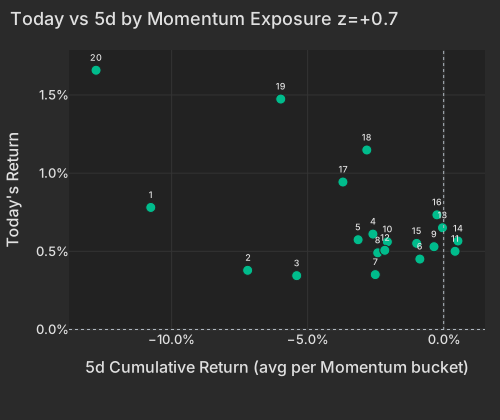
| Bucket | Ret 5D Pct | Today Ret Pct |
|---|---|---|
| 1 | -10.76 | 0.78 |
| 2 | -7.20 | 0.38 |
| 3 | -5.40 | 0.34 |
| 4 | -2.60 | 0.61 |
| 5 | -3.14 | 0.57 |
| 6 | -0.88 | 0.45 |
| 7 | -2.51 | 0.35 |
| 8 | -2.42 | 0.49 |
| 9 | -0.36 | 0.53 |
| 10 | -2.07 | 0.56 |
| 11 | 0.42 | 0.50 |
| 12 | -2.16 | 0.51 |
| 13 | -0.04 | 0.65 |
| 14 | 0.52 | 0.57 |
| 15 | -0.99 | 0.55 |
| 16 | -0.25 | 0.73 |
| 17 | -3.70 | 0.94 |
| 18 | -2.83 | 1.15 |
| 19 | -5.99 | 1.47 |
| 20 | -12.78 | 1.66 |
The Oil factor rose to z=+0.55 following news that Japan will divert 100% of its July crude imports away from the Strait of Hormuz, underscoring Middle East geopolitical risksBloomberg. The SPDR Energy Select Sector ETF (XLE) gained +0.71% as exploration and production equities absorbed the risk premium.
The bond market's reaction diverged from the energy shock. The US Dollar Index (DXY) strengthened +0.12% to 100.066CNBC, yet Treasury yields drifted lower. The 10-Year yield sits at 4.528%, down -1.2 bps, while the 30-Year fell -1.9 bps to 5.006%CNBC. Curve flattening indicates the fixed income complex is interpreting today's inflationary data as a tax on future economic growth rather than a catalyst for higher terminal rates.
The Producer Price Indexthe BLS (PPI) showed wholesale prices rising +1.1% in May, exceeding expectations as global energy shocks and AI infrastructure demand pushed input costs higher.
Initial Claimsthe BLS showed 229,000 filings for the week ending June 6—surpassing the 216,000 consensus and hitting a four-month highdol.gov. The weakening labor data contributed to growth-slowdown signals capping long-end yields.
Data compiled by FactorPulse AI; edited and verified by Jeff Klein. For informational purposes only. Does not constitute financial advice, an investment recommendation, or an offer to buy or sell any securities. Always consult a qualified financial professional before making investment decisions.
For more on factor construction methodology, see www.factorpulse.com/glossary.