Treasury proxies rose (z=+3.66) as retreating oil prices compressed the 10-Year yield to 4.52%, lifting rate-sensitive real estate and homebuilders.
High-beta semiconductor length unwound sharply, with AMD (-8.5%) and Micron (-8.0%) accelerating their losses into the close ahead of a liquidity drain from the impending SpaceX IPO.
Energy (z=-1.43) and precious metals gave back their safe-haven premiums following a formal ceasefire agreement between Israel and Iran.
June 9, 2026 16:16 ET
A $1.75 trillion SpaceX IPO triggered a sharp unwinding of high-beta tech exposure, diverging from a Treasury factor that rose (z=+3.66) as geopolitical risk premiums evaporated. The impending offering pulled capital from extended semiconductor positions, while a formal ceasefire between Israel and Iran sent oil prices lower and compressed the 10-Year yield to 4.52%.
Factor
Return
Z-Score
5d Z
20d Z
63d Z
Category
Direction
Treasury
+0.89%
z=+3.66
+2.43
+1.75
+0.26
Theme
treasury exposure outperforms
Residual Volatility
-1.55%
z=-3.03
-3.41
-0.33
+0.63
Style
low volatility outperforms
Retail+International
-0.38%
z=-1.96
-4.05
-1.73
-0.67
Style
retail and international names underperform
Profitability
-0.35%
z=-1.93
-1.88
-1.63
-1.15
Style
unprofitable names outperform
Oil
-0.97%
z=-1.43
-0.86
-0.58
-0.17
Theme
oil exposure underperforms
The Tech Liquidity Drain
An unwinding of momentum length pressured the market's highest-beta names. As institutional demand for the impending $1.75 trillion SpaceX IPO reached four times oversubscriptionEconomic Times, portfolio managers preemptively pulled liquidity from extended semiconductor positionsBloomberg. The resulting rotation drove the Residual Volatility factor to an extreme z=-3.03, punishing the most volatile cohorts. The rotation concentrated on the highest-beta names, which declined -8.80% on the session.
Single-stock declines accelerated late in the day. Advanced Micro Devices (AMD) fell -8.54%, dropping -4.76% in the last hour on elevated volume (1.18× typical). Micron (MU) shed -8.05%, erasing early momentum from UBS upgrades and HBM4 supply deficit projectionsFT. Intel (INTC) lost -7.63% on the day, with a -4.84% drop in the final hour. The sell-off reflects a broader reassessment of AI infrastructure costs, highlighted by Alphabet raising its 2026 CapEx guidance to $190 billionBloomberg while companies including Uber implemented hard caps on AI software spending.
Treasury Proxies Rally on Easing Inflation
While high-beta tech unwound, rate-sensitive equities rallied. The Treasury factor rose sharply to an extreme z=+3.66, completing a five-day acceleration (z_p5d = +2.43) as falling energy prices eased short-term inflation fears. The 10-Year Treasury yield compressed to 4.52%CNBC, down 2.6 bps on the day.
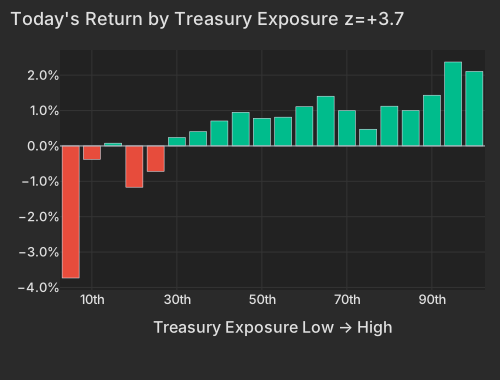
The cross-sectional impact was monotonic: the lowest-exposure Treasury names fell -3.70%, while high-exposure proxies gained. This dynamic propelled the Real Estate sector up +2.46%, with Homebuilders leading the ETF complex (XHB +3.48%) alongside Real Estate (IYR +2.35%).
The Treasury factor heavily punished the names with the lowest rate sensitivity today.
Today's Return by Treasury Exposure z=+3.7
Bucket
Avg Ret Pct
1
-3.73
2
-0.38
3
0.08
4
-1.17
5
-0.72
6
0.24
7
0.40
8
0.71
9
0.95
10
0.78
11
0.81
12
1.11
13
1.41
14
1.00
15
0.47
16
1.12
17
1.00
18
1.43
19
2.37
20
2.10
Geopolitical Risk Unwind
The primary catalyst for the yield compression was a decline in the Middle East geopolitical risk premium. A formal ceasefire agreement between Israel and Iran triggered a swift unwinding of the commodity defensive tradeNYTBloomberg. The Oil factor slid to z=-1.43 as the anticipated summer supply deficit failed to materialize in physical marketsFT. Energy exploration equities bore the brunt, with the XOP ETF falling -2.61% and USO down -2.64%.
ETF
Theme
Today
5d Ago
20d Ago
63d Ago
XHB
homebuilders
+3.48%
+0.06%
+0.76%
-1.82%
IYR
real estate
+2.35%
+1.49%
-1.64%
+1.86%
KRE
banking
+1.24%
+3.00%
+0.73%
+8.66%
TLT
long-term bonds
+0.70%
-0.99%
-1.70%
-5.17%
SMH
semiconductors
-1.30%
-1.59%
+5.58%
+51.67%
GLD
gold
-1.62%
-3.40%
-8.41%
-15.93%
XLK
technology
-1.86%
-5.92%
+4.93%
+31.78%
XOP
oil
-2.61%
+0.31%
+1.96%
+4.06%
USO
oil
-2.64%
-0.26%
+1.17%
+29.54%
SLV
silver
-4.08%
-9.00%
-15.66%
-21.31%
The safe-haven unwind extended beyond energy. Precious metals retreated alongside crude, with the SPDR Gold Shares (GLD) dropping -1.62% and the iShares Silver Trust (SLV) declining -4.08% as pro-cyclical positioning replaced defensive hedging. The US Dollar Index (DXY) remained flat at 99.96CNBC, indicating the commodity weakness was driven by physical market supply rather than dollar strength.
Persistent Decline in Retail and International Flow
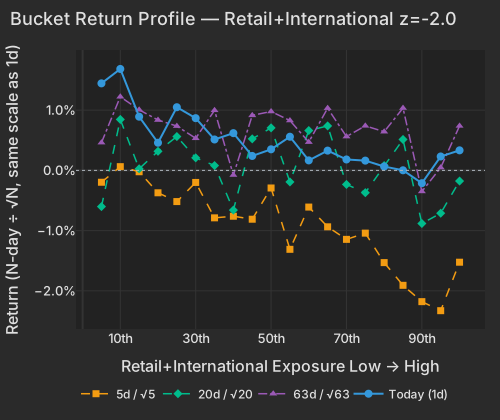
Beneath the headline sectoral shifts, the Retail+International factor extended a multi-week decline, hitting z=-1.96. The factor carries a negative trajectory across all tracked horizons (z_p5d = -4.05, z_p20d = -1.73).
Retail and international names have faced persistent, monotonic selling pressure across the 1-day, 5-day, and 20-day horizons.
The cross-horizon agreement indicates that market participants systematically offloaded retail and international exposures, maintaining selling pressure on these cohorts regardless of broader index direction.
Data compiled by FactorPulse AI; edited and verified by Jeff Klein. For informational purposes only. Does not constitute financial advice, an investment recommendation, or an offer to buy or sell any securities. Always consult a qualified financial professional before making investment decisions.