SpaceX and OpenAI's simultaneous IPO filings are poised to absorb up to $200 billion in institutional capital, directly draining public growth profiles (Growth z=-1.97).
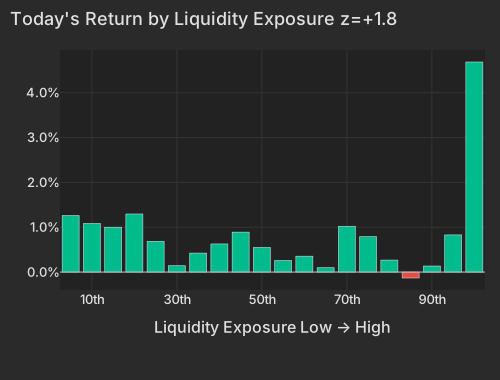
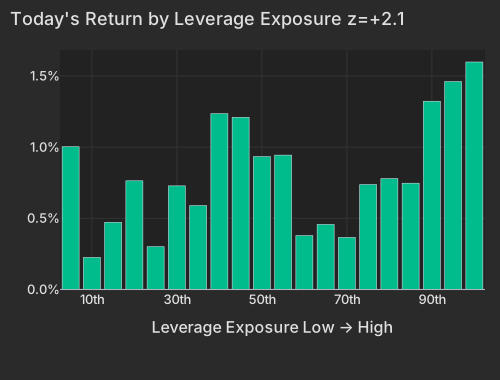
Portfolios are rotating into Leverage (z=+2.13) and Liquidity (z=+1.79) as managers optimize balance sheets and raise cash ahead of the new issuances.
The 10-year Treasury yield reached 4.61% following Jamie Dimon's warning on structurally higher rates, sustaining a 63-day structural tailwind for Dividend Yield (z=+1.45).
Nvidia fell -1.57% despite an 85% revenue increase, while Intuit declined -19.75% on a 17% workforce reduction tied to AI commoditization fears.
May 21, 2026 14:33 ET
The prospect of a $200 billion institutional liquidity drain from the impending SpaceX and OpenAI IPOs is re-anchoring public equity regimes. Capital is rotating out of established growth factors and into high-liquidity, high-leverage profiles, accelerating a shift already pressured by Jamie Dimon's warning on structurally higher interest rates. The result is a pronounced decline for duration-sensitive software and consumer discretionary stocks, while asset-heavy and dividend-paying sectors attract defensive flows.
Factor
Return
Z-Score
5d Z
20d Z
63d Z
Category
Direction
Leverage
+0.32%
z=+2.13
1.04
0.68
-1.15
Style
high leverage outperforms
Growth
-0.47%
z=-1.97
-1.14
-0.57
-0.42
Style
growth underperforms
Liquidity
+0.78%
z=+1.79
1.01
1.29
1.15
Style
high liquidity outperforms
Dividend Yield
+0.27%
z=+1.45
-0.16
1.58
2.05
Style
higher yield outperforms
Beta
+1.39%
z=+1.22
-0.39
0.65
1.33
Style
cyclical names outperform
SpaceX's filing for a June Nasdaq debut targeting a $2 trillion valuation, alongside OpenAI's confidential preparations for a September listing at a $1 trillion target, has triggered an immediate reallocation of institutional capital. These dual mega-cap offerings are estimated to absorb up to $200 billion in public market commitments. The factor tape captures the resulting capital drain: the Growth factor is under pressure at z=-1.97. This is a left-tail-driven rotation where the lowest-growth cohort is outperforming by +3.6% today, indicating a systematic offloading of premium public growth assets to fund private market entries. Simultaneously, the Liquidity factor rose to z=+1.79 as managers seek out the deepest trading vehicles to execute these block transitions.
High-liquidity names are rewarded today as institutional portfolios execute large-scale capital raising.
The rotation out of growth is reinforced by Jamie Dimon's warning to bond investors that structural savings shortages and massive fiscal deficits will drive interest rates higher from current levelsBloomberg. The Treasury curve reflects this sustained pressure, with the 10-year yield reaching 4.61%CNBC. In this credit-constrained regime, the Leverage factor leads the board at z=+2.13. High-yield credit spreads remain tight, driving a right-tail outperformance where capital-intensive firms executing proactive debt restructurings are rewarded. Seagate Technology (STX) embodies this dynamic, climbing +4.46% following a $185.9 million note exchangeReuters. Meanwhile, the Dividend Yield factor (z=+1.45) continues its structural multi-week trend. With a 63-day z-score of 2.05, defensive yield has established a persistent regime of outperformance.
The Leverage factor is experiencing a right-tail-driven rally, with the highest exposure bucket returning +1.5%.
ETF
Theme
Today
5d
20d
63d
EWY
south korea
+3.47%
-4.52%
+15.60%
+33.21%
IWM
small cap
+1.27%
-0.99%
+1.23%
+5.77%
XHB
homebuilders
+1.15%
-0.06%
-9.09%
-16.06%
XLK
technology
+0.63%
+0.16%
+12.05%
+26.34%
USMV
minimum volatility
+0.04%
+1.69%
+1.92%
-0.16%
IGV
software
-0.68%
+5.33%
+5.16%
+14.11%
XLE
energy
-1.65%
+3.77%
+5.77%
+8.37%
XOP
oil
-2.72%
+3.80%
+3.85%
+15.44%
The retreat from software and consumer discretionary is surfacing in idiosyncratic earnings reactions. Intuit (INTU) declined -19.75% on a 17% workforce reduction as investors priced in the risk that AI will commoditize its core TurboTax software suite. Walmart (WMT) dropped -7.4% after management warned that unplanned fuel costs are compressing operating margins, a casualty of ongoing geopolitical disruptionsMorningstar. Energy volatility remains central to the macro narrative; Brent crude is trading above $105 per barrel as the Strait of Hormuz effectively remains closed, slashing transit capacity by 95% and forcing global shipping lines to absorb war risk surchargesThe Guardian.
Despite the broader growth liquidation, specific pockets of the artificial intelligence hardware stack remain bid, holding the Beta factor positive (z=+1.22). Nvidia (NVDA) reported an 85% revenue increase to $81.6 billion, yet shares fell -1.57% as the print met high market expectations. However, Nvidia's $20 billion forward forecast for its standalone Vera CPU drove adjacent architecture plays. ARM Holdings (ARM) gained +11.96% on the read-through, while SanDisk (SNDK) climbed over +5.00% on NAND shortage projections. In an environment punishing generalized tech exposure, capital is concentrating in the physical infrastructure layer.
Economic Context
Initial jobless claimsbls.gov fell to 209,000 for the week ending May 16, beating consensus estimates of 210,000 and reinforcing a stable employment picture that gives the Federal Reserve runway to maintain restrictive policyBLS. Conversely, the Philadelphia Fed Manufacturing Index fell to a reading of -0.4 in May against expectations of 18.0, marking the first contraction of 2026 as new orders stalled, though forward-looking six-month activity expectations reached a five-year highMorningstar.
Data compiled by FactorPulse AI; edited and verified by Jeff Klein. For informational purposes only. Does not constitute financial advice, an investment recommendation, or an offer to buy or sell any securities. Always consult a qualified financial professional before making investment decisions.